










O seu guia para a soberania!
Oil at US$ 100, stock markets falling and Bitcoin rising. What's going on?
Share your love

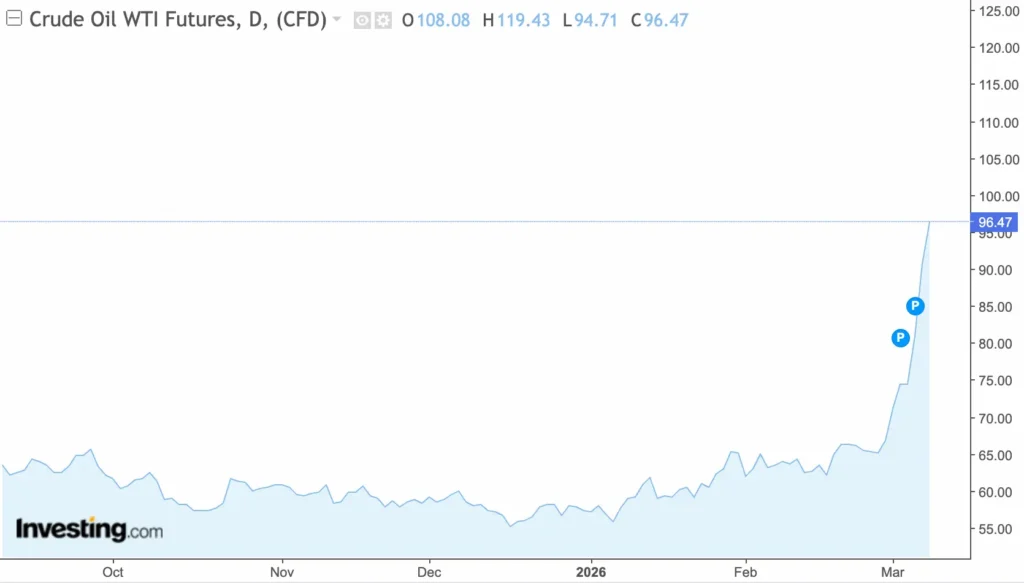
On Sunday, March 8, oil exceeded US$ 100 a barrel for the first time since the Russian invasion of Ukraine in 2022. On Monday morning (9), Brent reached US$ 108, and American oil reached US$ 115.
The context is the military escalation between the US, Israel and Iran, which began on February 28. Iran has closed the Strait of Hormuz, the route through which transits approximately 20% of all the world's oil.
Refineries in the region have been hit by Israeli attacks, and countries like the UAE and Kuwait have already reduced production. The supply shock is described by analysts as the most acute in decades.
In response to rising prices, President Trump said in Truth Social that this is a “small price to pay” for global security, projecting that prices will “fall rapidly” after the end of the conflict.
Sovereign
Pay
Your pocket Swiss bank.
Copper via PIX anonymous and receive it at Bitcoin, dollar or balance in international card.
Knowing
Only 9 vacancies
The reaction of traditional markets
The opening of the markets on Monday reflected the climate of uncertainty. The Nasdaq 100 and S&P 500 fell by more than 1.5%. Gold, historically sought as a store of value in times of crisis, fell 1.6%. Silver fell by 1.1%. The US dollar appreciated against the main currencies, a move typical of periods of risk aversion.
The scenario puts central banks in a delicate position. More expensive energy puts pressure on inflation, which was already a challenge before the conflict. Keeping interest rates high to contain this pressure, on the other hand, reduces global liquidity and weighs on economic growth. The European Central Bank has warned that a prolonged conflict could combine higher inflation with weaker growth, one of the most difficult scenarios for monetary policy.
Bitcoin's behavior
While traditional assets retreated, Bitcoin registered an increase of 2.8% since midnight UTC on Monday, a behavior that caught the attention of analysts from the Coindesk, This is because the asset is usually classified as part of the risk class and tends to fall in times of generalized aversion.
It wasn't always like this in this cycle. When the attacks on Iran began at the end of February, BTC reached fall below US$ 64 thousand. The recovery, however, was relatively quick, and since then Bitcoin has remained in the range of US$ 67 to 70 thousand, without keeping up with the downward pressure seen on the stock exchanges.
Analysts point to a number of hypotheses to explain this behavior:
- American exposure to the oil market. The US is now a net exporter of energy. A supply shock in the Middle East tends to have a more pronounced effect on Europe and Asia than on the American economy. Bitcoin, increasingly traded via ETFs listed in the US and with an American institutional base, may be benefiting from this asymmetric dynamic.
- Flows to decentralized assets. Some analysts are observing the movement of capital that, in previous crises, would have gone into gold, and is now partly going into Bitcoin. The hypothesis is that in times of intense geopolitical tension, a portion of investors seek exposure to assets outside the conventional financial system.
- Rise in privacy cryptocurrencies. Additional data from the session: Monero (XMR), Zcash (ZEC) and Dash rose between 4% and 5.2%, outperforming Bitcoin and Ethereum in the period. The movement is interpreted by some analysts as reflecting greater interest in assets with privacy and autonomy characteristics in periods of instability.
The risks ahead
The resilience seen today does not eliminate the medium-term risks. If the conflict continues and oil stays above US$ 100 for months, the inflationary impact could force central banks to tighten their stance, which historically puts pressure on risk assets across the board, including crypto-assets.
In 2022, when oil rose above US$ 100 after the invasion of Ukraine, Bitcoin lost more than 70% of its value over the course of the year, against a backdrop of aggressive interest rate hikes by the Fed. The current environment has similarities, but also significant differences: the presence of institutional ETFs, the lower volume of BTC available on exchanges and the level of corporate and sovereign adoption are all higher than in 2022.
Whether this Monday's behavior represents a more structural change in Bitcoin's correlation with geopolitical shocks, or whether it is a one-off response before a realignment with risk assets, it is too early to conclude.




 English