Breaking News





Your Guide to Sovereignty
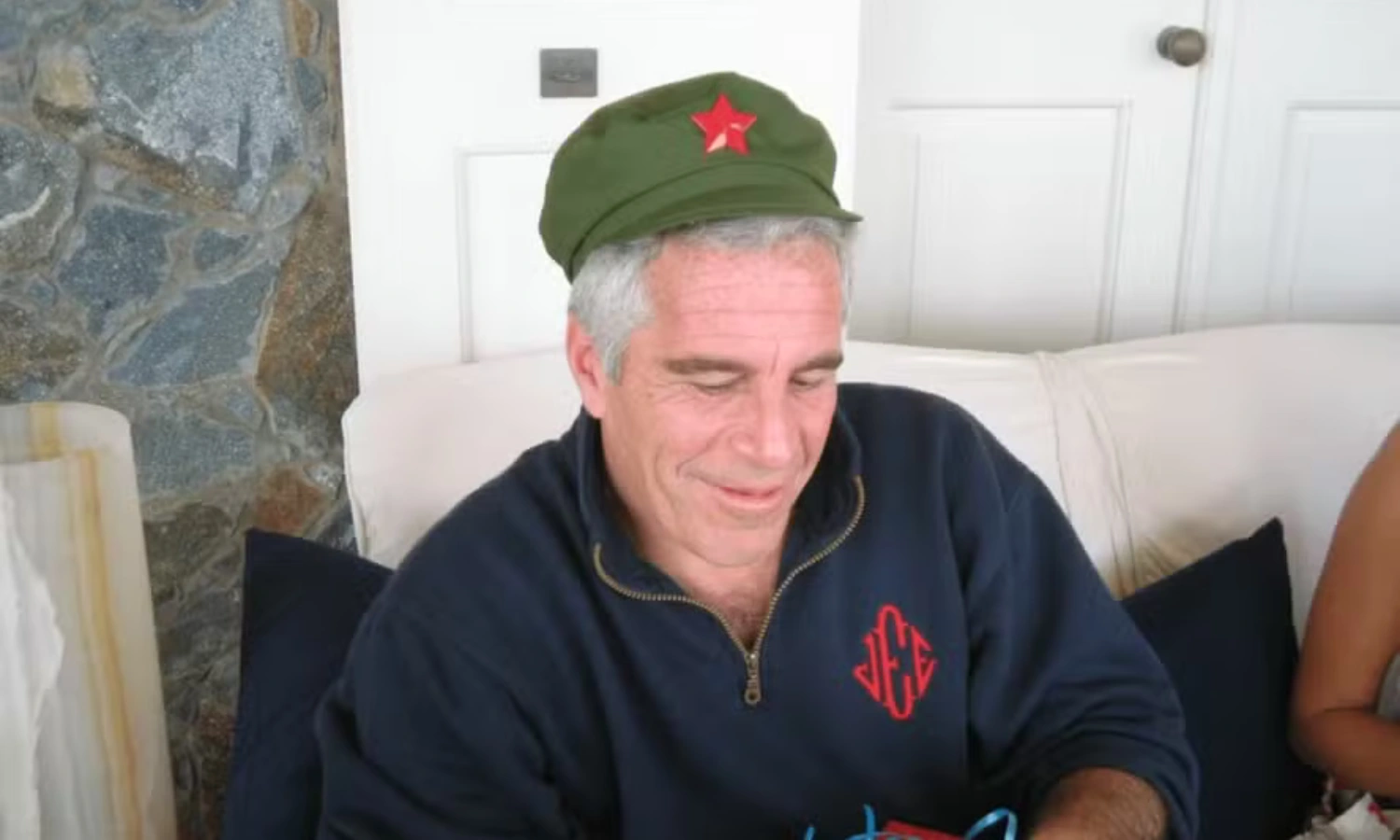
The release of files relating to the case of financier and sex offender Jeffrey Epstein by the US government has revealed the billionaire's links to crypto projects and Russian dictator Vladimir Putin.
In a recent publication, the news site Kyiv Independent has collected all the main mentions of Putin in the Epstein Archives. The main one is FBI document which quotes Epstein as Putin's possible asset manager, He also performed the same service for Zimbabwe's dictator at the time, Robert Mugabe.
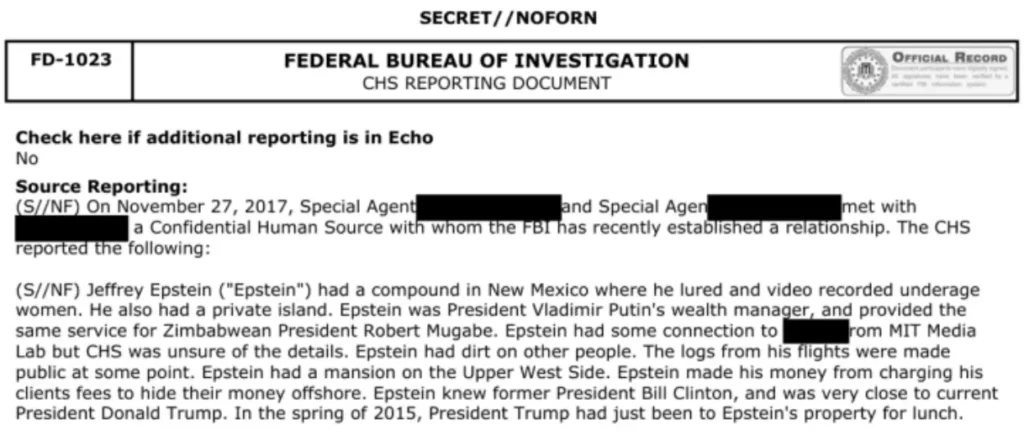
The article cites that the document is an FD-1023 form, an FBI standard used to record information from confidential human sources. “It reflects unsubstantiated allegations made during a 2017 meeting with FBI agents, and no conclusions verified.”
The undisclosed source accuses the Wall Street investor of making his fortune by charging fees to his clients in order to “hide his money offshore”. Although there is speculation that his fortune grew with financial scams such as pyramids Towers Financial, whose founder Steven Hoffenberg himself claimed that Epstein was involved, but this was never proven in court.
What was most striking, however, was his proposal that Russia “reinvent the financial system of the 21st century”. Epstein planned to present his supposed revolutionary solutions to the current president of Russia, although it is still uncertain whether he ever met with Putin to talk about it or not.
It is also present in the Epstein Archives (which can be checked in full at justice.gov/epstein) a email of 2014 where Jeffrey tries to contact Putin through Thorbjorn Jagland, then Secretary General of the Council of Europe and former Prime Minister of Norway, to explain his idea of creating a Russian digital currency.
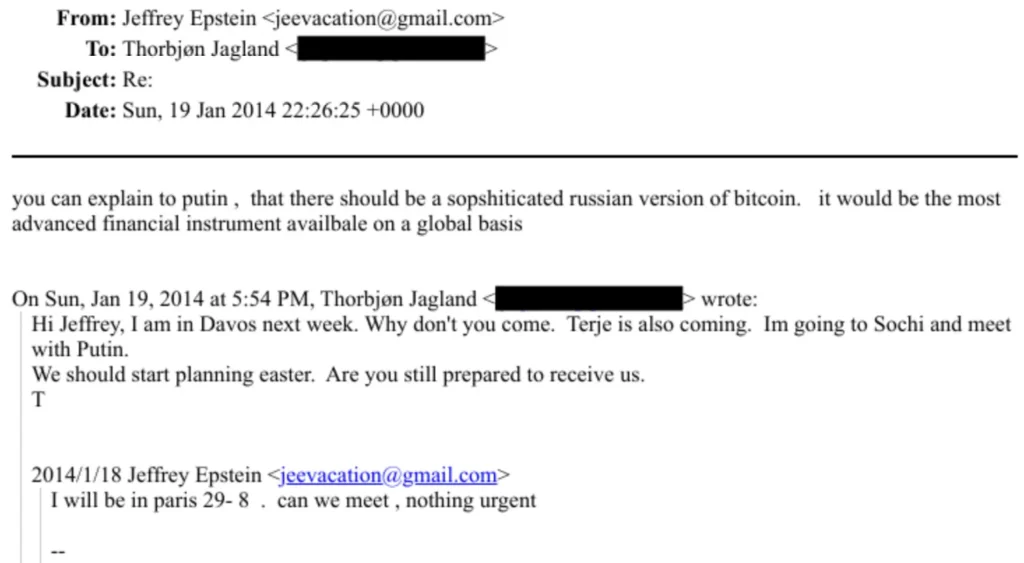
“Can you explain to Putin that there should be a sophisticated russian version of bitcoin. It would be the most advanced financial instrument available on a global basis,” said Epstein.
In another email exchange between the two a year earlier, Epstein wrote:
“When Sputnik was announced, the West was taken by surprise. The same could happen now with Russia taking the lead in finance. Instead of competing with the West for nanotechnology, copying Silicon Valley, looking for startups, trying to catch up with Microsoft, Apple, Google and the like, Russia can get ahead and overtake the global community by reinventing the financial system of the 21st century.”
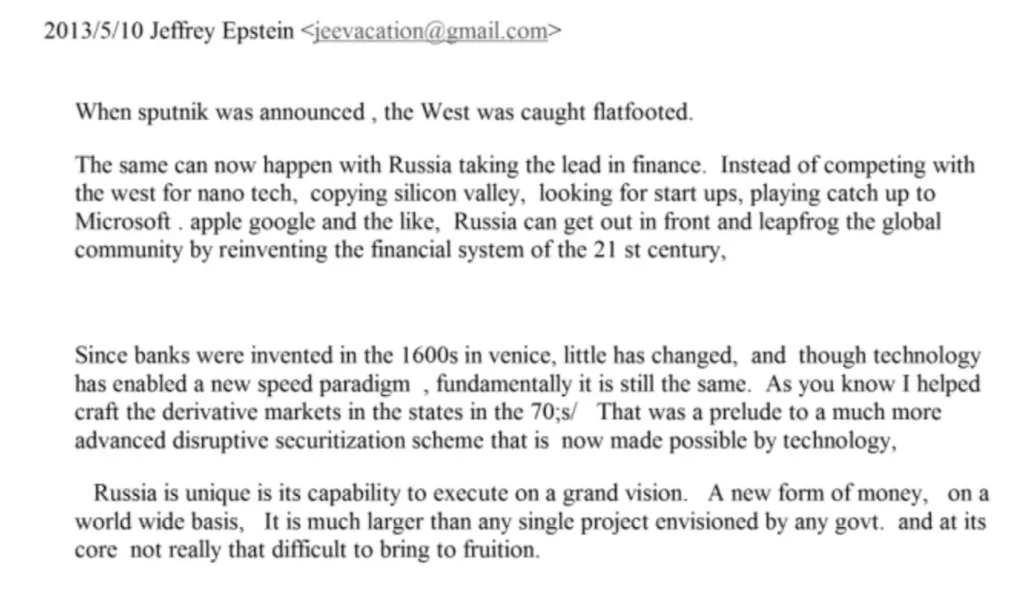
He added: “Russia is unique in its ability to execute a great vision. A new form of money, It is much bigger than any single project envisioned by any government and, in essence, it is not really that difficult to realize.”.
To which Jagland replied that it wouldn't be easy for him to explain this to Putin, and that Epstein should do it. “My job is to get a meeting with [Putin],” he said.
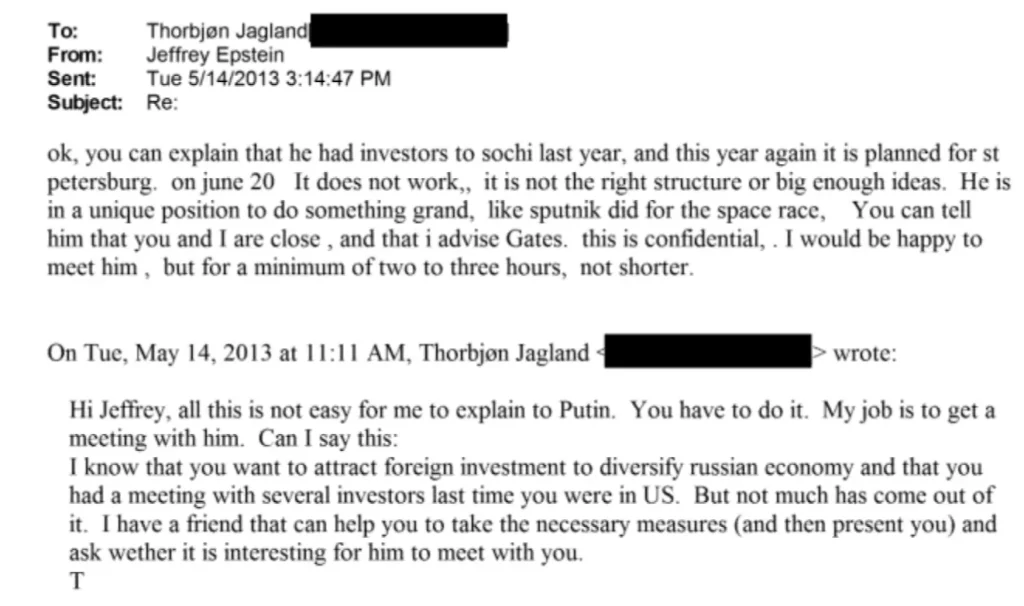
Epstein concluded by saying Putin would be “in a unique position to do something great, like Sputnik did for the space race”. “You can tell him that we are close and that I advise [Bill] Gates. That's confidential. I would be happy to meet with you, but for a minimum of two to three hours, no less,” he wrote.
The files also reveal message exchanges between Epstein and Sergei Belyakov, who was Russia's deputy economy minister from 2012 to 2014 and then chaired the St. Petersburg Economic Forum Foundation until 2015.
Belyakov graduated from the Academy of the Federal Security Service (FSB). responsible for training Russian intelligence officers.
In 2014, he helped with Epstein's Russian visa application and arranged possible meetings with the then deputy finance minister, Sergei Storchak, and the deputy chairman of the Central Bank, Alexei Simanovsky.
In return, Epstein offered Belyakov a list of high-level international guests for the forum.
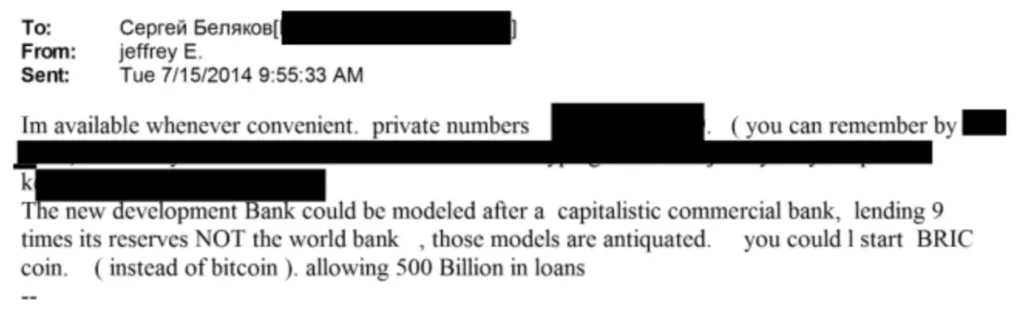
In the conversations, the financier suggested that Russia create a bank capable of lending “nine times its reserves” and proposed the launch of a cryptocurrency called BRIC, presented as an alternative to Bitcoin.
By coincidence or not, years later, around 2022, the Russian state began to talk openly about creating a common currency for the BRICS bloc as a way of reducing the impact of Western sanctions.
An idea that won the support of Brazil's president, a member country of the bloc. In April 2023, during an official visit to China, another BRICS member country, Lula said: “Why can't we trade based on our own currencies? [...] Who decided that the dollar was the standard currency?”
In addition to the messages in which he sought to get closer to Russia, the files released show that Jeffrey Epstein followed the development of Bitcoin since its early years and sought direct dialogue with names in the sector.
The documents indicate that Epstein had contact with developers and entrepreneurs in the crypto ecosystem as early as the first half of the 2010s, when Bitcoin was considered a niche experiment.
Still in 2011, Epstein sent an email to a contact censored by the U.S. Department of Justice saying he wanted to talk to “the bit coin guys".” (sic).
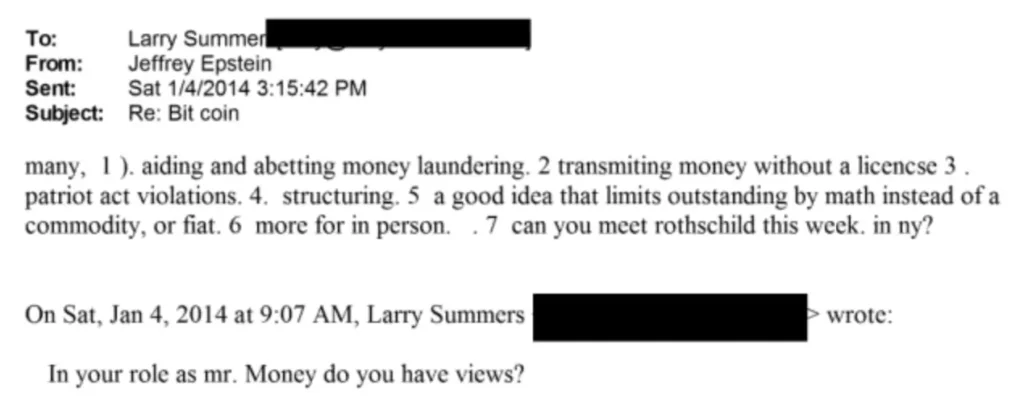
In a 2014 email, Epstein made it clear that his ideas were not related to ethos of Bitcoin (individual sovereignty), but rather financial crimes such as terrorist financing. “[I have] many [views], 1) complicity in money laundering. 2) transmitting money without a license. 3) violations of the Patriot Act...” he wrote.
In others moments, Epstein discuss with some names, including Austin Hill (former CEO of Blockstream), about the possibility of creating Sharia Coin, a cryptocurrency based on the principles of Murabahah and Wadiah.
In Islamic finance, interest, excessive speculation and certain activities - such as alcohol and gambling - are considered forbidden. In other words, resistance to censorship, a fundamental aspect of Bitcoin, would be incompatible with Sharia Coin. This idea would have been presented to names linked to Saudi Arabia and Qatar.
Finally, there is no evidence that Epstein had any relevant role in the technical development of Bitcoin or any real influence on the sector, But the files make it clear that he was following the topic and had ideas about creating competing currencies to BTC to present to global leaders.
 Português do Brasil Português do Brasil
  English
 Español