Breaking News




Popular News




Your Guide to Sovereignty
Stablecoins are no longer just auxiliary instruments of the crypto market, but have now come to occupy a prominent place in the digital world. This is what a recent report from TRM Labs, which analyzes the expansion of these digital currencies paired with assets such as the dollar.
One of the study's main conclusions is that use is largely legitimate and that the illicit component represents a tiny fraction of the total volume transacted.
According to the survey, more than 99.5% of the volume moved in stablecoins is associated with activities considered legal. The data reinforces the idea that these assets are being integrated into the formal economy, acting as an operational layer between the traditional banking system and blockchains.
The report highlights that stablecoins have reached significant scale in recent years, being widely used for international settlement, remittances, arbitrage between platforms, protection against volatility and integration with regulated financial services.
Instead of remaining restricted to speculative niches, these assets have come to serve as a means of digital settlement in global markets. Stablecoins such as USDT and USDC have become central parts of the crypto market infrastructure, offering predictability of value in a volatile environment.
By being backed by fiat currencies, these stablecoins facilitate the transition of capital between banks, fintechs, exchanges and decentralized protocols, operating as a technological “bridge” between the two financial worlds.
Although illegal activities do exist, the study points out that they represent less than 0.5% of the total volume and are highly concentrated in specific networks and groups. Rather than a diffuse, structural problem, the report describes a pattern of concentration that allows for greater monitoring and intervention capacity.
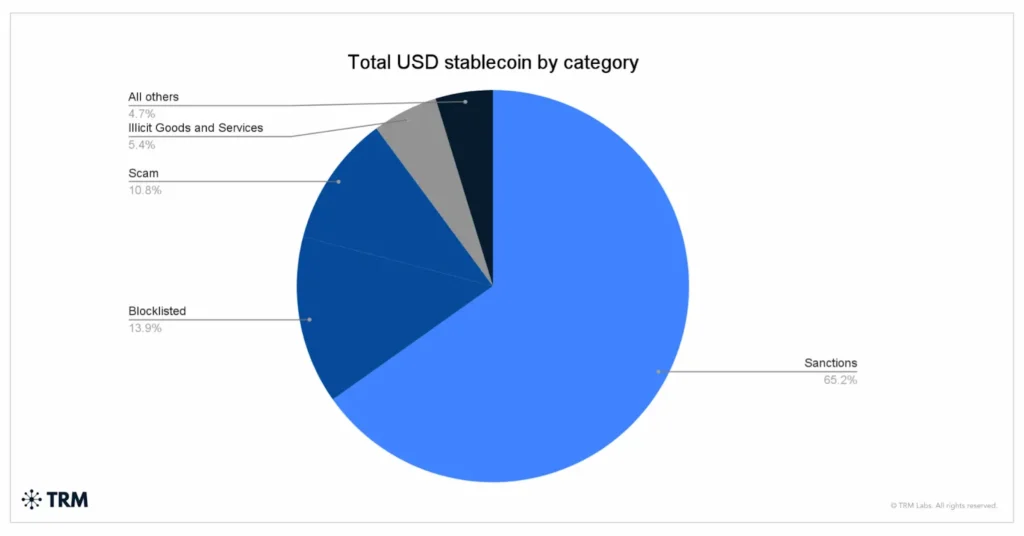
The very architecture of stablecoins, especially those issued by centralized entities, makes it possible to freeze assets and block addresses associated with sanctions or financial crimes. According to the analysis, this feature helps to limit the expansion of illicit use and strengthens cooperation between issuers, authorities and compliance companies.
The report also contextualizes the expansion of stablecoins within a more attentive regulatory environment. As governments discuss specific legal frameworks for these assets, the sector presents data that indicates a predominance of legitimate use and growing integration with traditional financial institutions.
The TRM Labs study challenges the idea that stablecoins are dominated by criminal activity. Although it recognizes risks and the need for continuous monitoring, the analysis maintains that the market is mostly made up of legitimate transactions.
With accelerated growth, integration into the financial system and more robust control mechanisms, stablecoins seem to be going through a consolidation phase: they are no longer an experiment and are taking on a strategic position as an operational link between banks and the digital world.
Do you want to deepen your understanding of Bitcoin and financial sovereignty? If you have any questions, want to better organize your studies or understand how to use sovereign tools in a practical and safe way, fill in the form below.
 Português do Brasil Português do Brasil
  English
 Español